
Jumping Spider Nutrition in Captivity: An Evidence-Based Feeding Guide
By Haley Burgess, www.littlespiderfriends.com
Introduction
Jumping spiders are often described as tiny predators, and that is true: they need live prey to grow, molt, and survive. But research shows their nutrition is more complex than simply “feed them bugs.” Some jumping spiders eat a wide variety of prey in the wild, and some also feed on nectar or sugar-rich liquids from flowers. This means the best captive diet should include safe live prey, variety, proper prey size, hydration, and occasional nectar-style carbohydrate support.

This guide focuses mostly on commonly kept Phidippus jumping spiders, such as Phidippus audax, Phidippus regius, and Phidippus johnsoni, but many ideas may also apply to other salticids.
Jumping Spiders Need More Than “Any Bug”
In the wild, jumping spiders are active hunters. They use excellent vision to notice movement, stalk prey, and jump onto it. Nelson et al. explains that jumping spiders have “acute vision and intricate vision-guided prey-capture behaviour” (Nelson et al., 2001).
This matters in captivity because food should not only fill the spider’s abdomen. Food should also support:
growth
molting
energy
hydration
hunting behavior
healthy body condition
A spider fed the same feeder continuously may survive, but survival alone is not the same as balanced nutrition.
What Wild Phidippus johnsoni Eat
One important study by Robert R. Jackson looked at prey eaten by Phidippus johnsoni in the field. Jackson found that P. johnsoni was not a specialist eating only one type of prey. He wrote, “Field data indicate that P. johnsoni is an euryphagous predator” (Jackson, 1977).
“Euryphagous” means it eats a wide variety of prey.
Jackson recorded P. johnsoni eating flies, aphids, caterpillars/moths, bees, ants, beetles, earwigs, harvestmen, and other spiders (Jackson, 1977).
This does not mean captive jumping spiders should be fed wild insects or other spiders. It means their natural diet is varied, so captive diets should also include variety using safe captive-bred feeders.

Prey Size Matters
One of the most useful husbandry findings from Jackson’s study is about prey size. He wrote, “Prey size tends to be one quarter to three quarters the size of the predator” (Jackson, 1977). A practical captive-care guideline is that most prey should measure about 25-75% of the spider’s body length.
Avoid prey that is:
larger than the spider
aggressive
hard-bodied
able to bite
left unattended during premolt

Why Flies Should Be a Major Feeder
In Jackson’s prey table, flies, also called Diptera, were the largest prey group by number. Diptera made up 30.30% of the recorded prey items (Jackson, 1977). This supports using flies often in captivity.
Flies are good feeders because they:
move naturally
trigger hunting behavior
are soft-bodied
are less likely to injure the spider than crickets
encourage exercise
are available in sizes for slings, juveniles, and adults
Many pet keepers rely too heavily on crickets and mealworms. Flies appear to be one of the most natural and useful staple feeders for many jumping spider species.
Fruit Flies: The Best Starter Feeder for Slings
Fruit flies are usually the first feeder for baby jumping spiders, also called slings.
The two most common types are:
Drosophila melanogaster
These are the smaller fruit flies. They are best for:
i2 slings
i3 slings
very tiny species
newly separated babies
They are usually easier for tiny spiderlings to catch. Petco describes Drosophila melanogaster as commonly cultured fruit flies measuring about 1/16 inch.
Drosophila hydei
These are larger fruit flies. They are best for:
larger slings
i3–i6 juveniles
spiders too large for melanogaster but not ready for bottle flies
They reproduce more slowly than Drosophila melanogaster, but each fly provides more food.
Wingless vs. flightless fruit flies
These terms are often confused. Wingless fruit flies have no usable wings. Flightless fruit flies may have wings, but they cannot fly normally. For jumping spider keepers, both can work, but flightless cultures are the most common.

Where to Get Safe Flies
Buy feeder flies from trusted feeder insect companies, reptile stores, invert breeders, or biological supply companies. Josh’s Frogs sells fruit fly cultures and states that their Drosophila melanogaster cultures are ready to feed shortly after arrival and are kept at recommended temperature and humidity ranges for production.
Common places to look include:
Josh’s Frogs
Rainbow Mealworms
local reptile stores
invert expos
Carolina Biological or other biological supply companies
trusted local feeder breeders
Keep multiple cultures if you have many slings. Fruit fly cultures can crash, mold, dry out, or become mite-infested.
Never Feed Wild-Caught Insects
This is one of the most important rules in beginner jumping spider care:
Do not feed wild-caught insects.
Wild insects can carry:
pesticides
parasites
mites
bacteria
fungal spores
unknown toxins
defensive chemicals from plants they ate
Even if your yard looks safe, insects may have traveled from treated areas. Some wild insects are also dangerous prey. Ants can spray defensive chemicals, beetles can bite, caterpillars may contain toxins, and wild spiders can injure or kill your spider.
Ovipost, a feeder insect company, warns that wild insects may expose pets to diseases, parasites, and pesticides, and recommends store-bought or home-bred feeders instead.
For jumping spiders, this rule is especially important because they are small. A tiny amount of pesticide or a single dangerous prey item could be fatal.
Nectar: The Missing Piece in Jumping Spider Nutrition
For a long time, many people assumed spiders only ate animal prey. But research shows some jumping spiders also feed on nectar.
Nelson et al. studied nectar feeding in jumping spiders and wrote, “Thirty one of the species studied were observed feeding on nectar from flowers in nature” (Nelson et al., 2001). They also found, “All species fed from flowers in the laboratory” (Nelson et al., 2001). This is important because it shows nectar feeding is not just a random accident. It may be a normal behavior in many jumping spiders. Nelson et al. concluded, “Nectar feeding is widespread, if not routine, in this large family” (Nelson et al., 2001).

Are They Drinking Water or Eating Sugar?
A good question is: are jumping spiders actually using nectar as food, or are they just drinking it for water?
Nelson et al. tested this by offering jumping spiders two choices: one strip soaked in 30% sucrose solution and one strip soaked in distilled water. The spiders spent more time feeding from the sucrose solution than the water (Nelson et al., 2001). The researchers explained that the importance of sugar in solution to salticids was demonstrated through these choice tests, in which spiders consistently spent more time drinking from the sucrose solution than from distilled water (Nelson et al., 2001). This suggests the sugar content itself is biologically important
The authors also explain, “Nectar is a sugar solution, not simply water” (Nelson et al., 2001). So nectar should be thought of as a carbohydrate source, not just hydration.
Why Carbohydrates May Help Jumping Spiders
A 2022 study by Wiggins and Wilder tested whether liquid carbohydrates helped Phidippus audax, the bold jumping spider. They wrote, “We tested if an actively hunting predator, the jumping spider, Phidippus audax, benefited from liquid carbohydrates when prey were not limited” (Wiggins & Wilder, 2022).
In the study, spiders were fed live Drosophila melanogaster fruit flies with different nutrient profiles. Half of the spiders also received a 20% sucrose solution (Wiggins & Wilder, 2022).
The results were important, “Spiders reared on high-protein diets with carbohydrates were larger and heavier than spiders on other treatments” (Wiggins & Wilder, 2022).
They also found, “Access to carbohydrates also increased percent body fat and survival across prey treatments” (Wiggins & Wilder, 2022).
Their conclusion is one of the most useful quotes for captive care, “Liquid carbohydrates can be an important nutrient to supplement a diet of prey rather than just being an energy supplement during periods of starvation” (Wiggins & Wilder, 2022). These findings suggest nectar-style feeding may help growing spiders balance their nutrition, not only survive periods of starvation.
Protein, Fat, and Carbohydrates: Simple Explanation
Think of spider nutrition like this:
Protein - Protein helps build the body. It supports growth, molting, and tissue.
Fat - Fat provides stored energy.
Carbohydrates - Carbohydrates provide quick energy.
Wiggins and Wilder explain that carbohydrates and lipids are often primary energy sources, while protein is often used to build new tissue (Wiggins & Wilder, 2022).
This is why carbohydrates may be helpful. If a spider only gets high-protein prey, it may have to use some of that protein for energy instead of growth. Wiggins and Wilder found that spiders grew largest on high-protein diets when carbohydrates were also available (Wiggins & Wilder, 2022). For pet owners, this means the goal is not just “more protein.” The goal is balanced nutrition.
Safe Nectar and Carbohydrate Options
Nectar should never replace live prey. It is a supplement.
Best option: diluted sucrose water
This is closest to the research because the studies used sucrose solutions.
Gentle nectar recipe
Mix:
1 part white sugar
5-10 parts water
Example:
1 teaspoon sugar
5-10 teaspoons water
Offer a tiny amount on a Q-tip, cotton wick, or small piece of paper towel. Remove it after the spider drinks.
The nectar study used 30% sucrose, and the P. audax study used 20% sucrose (Nelson et al., 2001; Wiggins & Wilder, 2022). For routine captive care, weaker solutions may be safer and less sticky than the concentrations used in laboratory studies.
Diluted honey water
Honey can work as a nectar-style carbohydrate, but it is stickier and can mold faster.
Mix:
1 drop honey
8-10 drops water
or:
1 teaspoon honey
8-10 teaspoons water
Use only a tiny amount. Remove it quickly.
Fruit options
Fruit is not nutritionally identical to flower nectar, but tiny amounts can provide moisture and carbohydrates.
Best fruit options:
watermelon
grape
blueberry
strawberry
apple
pear
How to offer fruit safely:
use a piece smaller than the spider’s abdomen
expose the juicy side
place it on a removable feeding ledge
remove within 4-12 hours
never let it mold or ferment
Avoid or use extreme caution with:
citrus
pineapple
banana
dried fruit
fruit syrup
canned fruit
anything with additives

How Often to Offer Nectar
These recommendations are cautious husbandry suggestions based on available research and keeper observations, not strict scientifically established feeding rules.
Stage | Nectar frequency |
i2-i3 slings | Usually skip unless weak or dehydrated |
i4-i5 slings | Tiny amount every 7-10 days |
Juveniles | Tiny amount once weekly |
Subadults | Once weekly unless in premolt |
Adult males | Every 1-2 weeks |
Adult females | Once weekly |
Gravid females | Small amount weekly if active |
Never force nectar. If the spider ignores it, remove it.
Feeding by Age and Instar
Instars are growth stages between molts. Exact timing varies by species, temperature, prey quality, and individual spider.
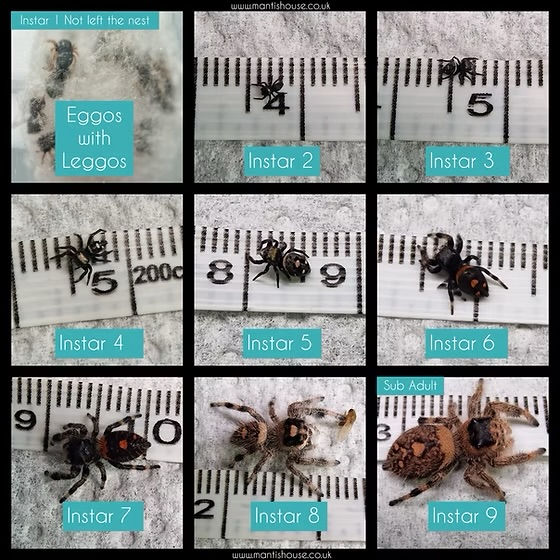
i1: Egg sac stage
The spiderlings are still in the egg sac or not independently feeding.
Feed: none
Nectar: none
i2: First independent sling
Feed every 1-2 days.
Best foods:
Drosophila melanogaster
tiny captive-bred springtails as backup only
Amount:
1-3 tiny fruit flies
Nectar:
usually skip
hydration is more important
i3: Tiny sling
Feed every 1-2 days.
Best foods:
Drosophila melanogaster
very small Drosophila hydei if the spider is large enough
Amount:
2-4 fruit flies
Nectar:
tiny diluted sucrose or honey water only occasionally
i4: Growing sling
Feed every 2 days.
Best foods:
Drosophila melanogaster
Drosophila hydei
tiny captive-bred flies
Amount:
2-5 fruit flies
Nectar:
tiny amount every 7-10 days
i5: Small juvenile
Feed every 2-3 days.
Best foods:
Drosophila hydei
tiny bottle flies
small captive-bred roaches
Amount:
1 small prey item
or several fruit flies
Nectar:
weekly, tiny amount
i6-i7: Juvenile
Feed every 3-5 days.
Best foods:
bottle flies
house flies
small roaches
occasional moths from captive sources
small crickets only with caution
Amount:
1 prey item around 25-75% of spider body length
Nectar:
once weekly
i8-ish: Subadult
Feed every 4-6 days.
Best foods:
bottle flies
house flies
small roaches
moths
occasional soft-bodied larvae
Amount:
1 appropriately sized prey item
Nectar:
once weekly unless in premolt
Adult male
Adult males often feed less frequently than juveniles and adult females. Jackson observed that adult male P. johnsoni seemed to feed less frequently than immatures and adult females (Jackson, 1977).
Feed every 5-10 days.
Best foods:
flies
moths
small roaches
Amount:
1 moderate prey item
Nectar:
every 1-2 weeks
Adult female
Adult females may need more energy, especially if gravid, but they are also easy to overfeed.
Feed every 4-7 days.
Best foods:
bottle flies
house flies
roaches
moths
Amount:
1-2 prey items depending on abdomen size
Nectar:
once weekly
Abdomen Size: The Best Feeding Guide
A schedule is helpful, but abdomen size matters more.
Underfed or dehydrated
Signs:
abdomen smaller than cephalothorax
wrinkled abdomen
low energy
What to do:
offer water first
offer appropriate prey
check temperature and enclosure conditions
Healthy abdomen
Signs:
abdomen slightly rounded
not tight or stretched
spider active and coordinated
What to do:
continue the current feeding schedule
Overfed
Signs:
very round abdomen
tight/shiny abdomen
trouble climbing
difficulty climbing or increased falling
less jumping
What to do:
wait longer before feeding
offer water, not prey
avoid fatty feeders


Feeder Insect Guide
Best staples:
Fruit flies
Best for slings.
Use:
Drosophila melanogaster for tiny slings
Drosophila hydei for larger slings and juveniles
Bottle flies and house flies
Excellent for juveniles, subadults, and adults. They encourage natural hunting and are supported by the fact that flies were a major prey group in Jackson’s P. johnsoni study (Jackson, 1977).
Small roaches
Good variety feeder. Use appropriately sized captive-bred roaches.
Moths
Can provide enrichment if captive-bred or obtained from reliable captive sources. Never use wild moths.
Use with caution:
Crickets
Crickets can bite or stress spiders. Never leave crickets unattended or overnight, especially with a spider in premolt or post-molt. Should only be used by experienced keepers.
Mealworms
Use as occasional treats. They can burrow and have tougher bodies.
Waxworms
Use rarely. They are fatty and should not be a staple.
Premolt and Post-Molt Feeding
Premolt
Signs:
hiding
building a thick hammock
refusing food
dull color
less activity
During premolt:
remove prey
do not disturb
maintain humidity
do not offer crickets
avoid nectar unless the spider is out and active
Post-molt
After molting, the spider’s body and fangs need time to harden.
Wait before feeding:
small slings: about 1-3 days
juveniles: about 3-5 days
adults/subadults: about 5-7 days
Offer water before prey.
What the Pet Community May Be Missing
1. Too much reliance on crickets and mealworms. Wild P. johnsoni ate a wide variety of prey, and flies were a major prey group (Jackson, 1977).
2. Not enough fly-based feeding. Flies are natural, stimulating, and safer than many aggressive prey items.
3. Not enough attention to carbohydrates. Nelson et al. found nectar feeding in many salticids, and Wiggins and Wilder found carbohydrate access improved growth, body fat, and survival in P. audax (Nelson et al., 2001; Wiggins & Wilder, 2022).
4. Feeding based on “will they eat it?” instead of “is it balanced?” A spider may accept a food that is not ideal as a staple.
5. Overfeeding. A very round abdomen is often seen online, but it is not always healthy.
Simple Beginner Feeding Plan
For a new owner, the easiest safe plan is:
Slings
feed flightless fruit flies every 1-2 days
use melanogaster first, then hydei
mist lightly or provide safe hydration
avoid large prey
Juveniles
feed every 2-5 days
use hydei, small bottle flies, and small roaches
offer tiny nectar weekly
Adults
feed every 4-10 days depending on sex and abdomen size
use bottle flies, house flies, roaches, and occasional moths
offer nectar weekly or every other week
never feed wild-caught insects
Conclusion
Research on captive jumping spider nutrition is still limited, and many husbandry practices combine scientific evidence with long-term keeper observations.
Jumping spider nutrition should be based on more than convenience. Research shows that Phidippus johnsoni eats a wide variety of prey in the wild, with flies making up a major prey group (Jackson, 1977). Research also shows that nectar feeding occurs in many jumping spiders and that sucrose is preferred over plain water in laboratory tests (Nelson et al., 2001). Finally, Phidippus audax spiderlings grew larger, heavier, and had better survival and body fat when given access to liquid carbohydrates along with prey (Wiggins & Wilder, 2022).
An ideal captive diet involves more than simply offering live insects. It must include all of the following:
safe captive-bred prey
correct prey size
variety
hydration
occasional nectar-style carbohydrates.
That approach better respects jumping spiders as active, intelligent predators with more complex nutritional needs than many beginners realize.
Works Cited
Jackson, Robert R. “Prey of the Jumping Spider Phidippus johnsoni (Araneae: Salticidae).” The Journal of Arachnology, vol. 5, 1977, pp. 145–149.
Nelson, Ximena J., Simon D. Pollard, Robert R. Jackson, G. B. Edwards, and Alberto T. Barrion. “Jumping Spiders (Araneae: Salticidae) That Feed on Nectar.” Journal of Zoology, vol. 255, 2001, pp. 25–29.
Wiggins, Will D., and Shawn M. Wilder. “Carbohydrates Complement High-Protein Diets to Maximize the Growth of an Actively Hunting Predator.” Ecology and Evolution, vol. 12, 2022, e9150.
Josh’s Frogs. “Producing Fruit Fly Culture: Drosophila melanogaster.” Josh’s Frogs.
Ovipost. “Never Feed Wild Crickets to Your Pet.” Ovipost, 2025.


Comments