
Understanding Jumping Spider Instars: Molting, Development, and Evidence-Based Care
By Haley Burgess, www.littlespiderfriends.com
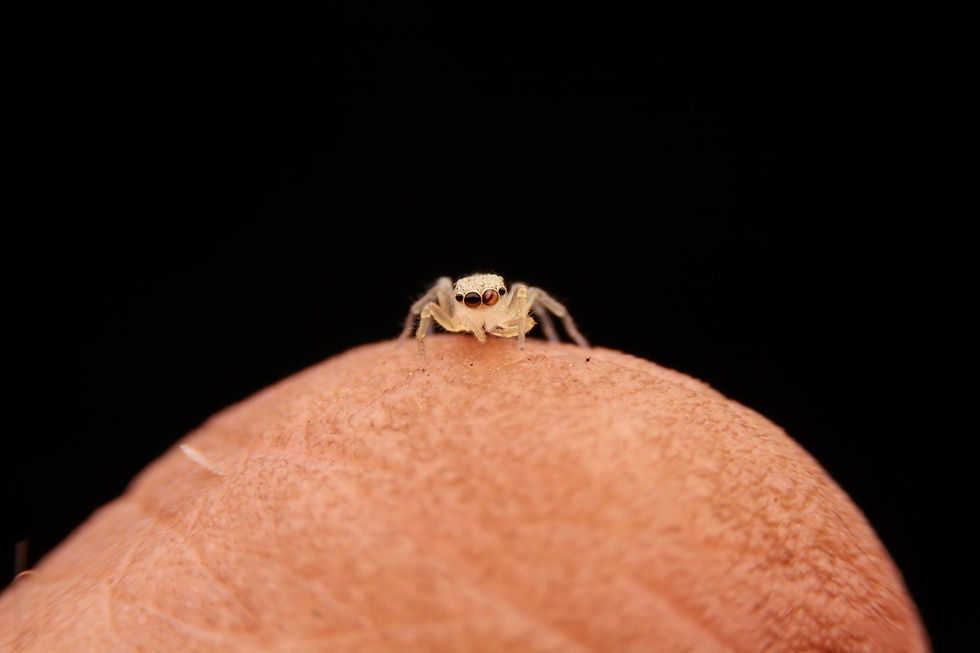
Jumping spiders are some of the most visually advanced and behaviorally complex spiders in the world. Their large forward-facing eyes, active hunting behavior, and curious personalities have made them increasingly popular in captivity. But one of the most misunderstood parts of keeping jumping spiders is understanding how dramatically they change as they grow.
A newly emerged spiderling does not behave, hunt, molt, or tolerate environmental conditions the same way as a larger juvenile, subadult, or adult spider. Their feeding needs change. Their molting behavior changes. Even their tolerance toward siblings changes throughout development.
Understanding these developmental stages is one of the most important parts of successful jumping spider husbandry.

Scientific studies on jumping spiders provide valuable insight into:
molting
developmental timing
feeding behavior
communal early instars
visual development
how environmental conditions affect growth and lifespan
This article combines scientific research with practical captive care information to explain:
what instars are
how jumping spiders molt
what happens during each developmental stage
how to recognize molts and developmental progression
how scientific data can help improve captive care
Adult jumping spiders are known for their “extraordinary eyesight and complex, visually guided behaviors” (Goté et al., 2019). But every jumping spider begins life inside an egg sac as a tiny, undeveloped spiderling that must molt repeatedly before reaching adulthood.
What Are Instars and Why Do Jumping Spiders Molt?
Unlike mammals, jumping spiders cannot grow continuously. Their bodies are protected by a hard outer exoskeleton that does not stretch as they grow. In order to become larger, they must periodically shed their old exoskeleton and form a new one underneath.
This process is called molting.
The period between each molt is called an instar.
For example:
a spider that has molted twice is in its second instar, or “i2,”
after another molt it becomes “i3,”
and so on until adulthood.
One of the most important things for keepers to understand is age is not the same as instar.
Two spiders of the same species and age can develop at very different rates depending on any of the following:
temperature
prey availability
hydration
feeding frequency
environmental conditions
stress
sex
Research on Phidippus johnsoni found that males generally mature earlier and after fewer molts than females (Jackson, 1978). The 2019 developmental study on jumping spider visual growth similarly found that males usually matured in approximately 6–8 instars, while females often required 7-9 instars before adulthood (Goté et al., 2019). This is one reason female jumping spiders are often noticeably larger than males.

Understanding Molting
Molting is one of the most important, and most vulnerable, periods in a jumping spider’s life. Before molting, spiders enter premolt. During premolt, the spider forms a new exoskeleton underneath the old one before eventually shedding the old exoskeleton completely.
Many new keepers panic during premolt because their spider may suddenly:
stop eating
remain hidden for long periods
become less active
spend more time in thick hammocks
appear darker in color
This is normal. Larger juveniles and subadults may remain hidden for days or even weeks before molting. One of the most important husbandry rules during premolt is do not disturb the spider unnecessarily.
Avoid:
handling
tearing open hammocks
excessive enclosure cleaning
moving the enclosure repeatedly
repeatedly attempting to feed
Stress during molting can increase the risk of failed molts and injury.
Freshly molted spiders are:
soft
fragile
vulnerable to falls
unable to defend themselves properly
Their new exoskeleton must harden before normal movement and feeding fully return.
Recently molted spiders may:
move awkwardly
slip more easily
refuse food
remain hidden while hardening
This is normal postmolt behavior.
How to Recognize a Molt
One of the biggest challenges for keepers is identifying molts, especially in very small spiderlings that remain hidden inside nests or communal hammocks.
Signs that a molt likely occurred include:
the spider suddenly appearing larger
brighter or fresher coloration
thicker legs
fuller appearance
visible shed exoskeleton (exuvia)
extended postmolt inactivity
Sometimes the exuvia is pushed outside the hammock, while other times it remains hidden inside.
Small spiderlings can be especially difficult to track because:
molts are tiny
siblings overlap in development
communal nests hide individual molts
exuviae may dry out quickly or be difficult to see

Growing Up: Instar by Instar
Egg Sac Stage
A jumping spider’s life begins inside an egg sac protected by the mother. Female jumping spiders often guard their egg sacs closely and may remain with them for weeks.
Inside the egg sac:
embryos develop
hatch
eventually emerge into the earliest developmental stages
Environmental stability is especially important during this stage. Avoid:
excessive moisture
stagnant wet conditions
dehydration
poor ventilation
Warm, humid, stagnant conditions can quickly become dangerous for developing spiderlings.
Postembryo Stage
One of the most misunderstood developmental stages in jumping spider husbandry is the postembryo stage. Jackson defined the postembryo as, “The stage beginning with rupture of the chorion and ending with the first true molt” (Jackson, 1978).
At this stage:
spiderlings remain clustered together
movement is limited
chelicerae are not fully functional
they do not actively hunt prey
Instead, they continue developing while relying on internal yolk reserves.
Husbandry During the Postembryo Stage
At this stage:
prey should not yet be introduced
disturbance should remain minimal
and humidity should stay stable without becoming overly wet
Because the spiderlings are still extremely vulnerable, this is not the stage for separation.
First Instar (i1)
After the first true molt, the spiderlings enter their first instar, or i1.
At this stage:
movement increases
body structure becomes more recognizable
spiderlings may begin exploring the brood nest more actively
However, they are still highly immature and usually remain grouped together.
Hill described first and second instars as showing “gregarious behavior in brood-sac” (Hill, 2006).
This is important because many keepers assume all spiderlings must immediately be isolated after hatching. In reality, very young spiderlings often naturally remain together during early development.
Husbandry During i1
During this stage:
spiderlings should generally remain grouped
disturbance should stay minimal
ventilation becomes increasingly important
prey should remain extremely small if introduced at all
Most i1 spiderlings are still too immature for larger prey items.

Second Instar (i2)
The second instar, or i2, is one of the most important developmental stages in jumping spider husbandry.
For many species, i2 marks the beginning of:
independent hunting
increased mobility
dispersal from the maternal nest
Jackson found that Phidippus johnsoni spiderlings dispersed from the maternal nest roughly three weeks after hatching (Jackson, 1978).
Around this stage, many keepers notice a dramatic behavioral shift. Spiderlings that previously stayed clustered together inside the nest suddenly become much more active and begin exploring their environment independently.
This is usually the stage where keepers begin offering:
melanogaster fruit flies
tiny hydei fruit flies
similarly small prey items
Husbandry During i2
One of the biggest debates in jumping spider husbandry is when to separate spiderlings. Many keepers separate immediately after dispersal, while others continue limited communal rearing during early i2 stages.
Early i2 spiderlings often show significant tolerance toward one another when:
prey is abundant
overcrowding is avoided
size differences remain minimal
During this stage, any keepers observe:
communal feeding
feeding in close proximity
and communal webbing
However, this tolerance decreases as spiderlings:
grow larger
become stronger hunters
and begin competing more aggressively for food

Signs It Is Time to Separate
Spiderlings should begin separation if you observe:
major size differences
food competition
aggressive interactions
prey stealing
missing limbs
cannibalism risk
Frequent feeding is especially important in communal setups because hungry spiderlings are much more likely to attack one another.


Mid Juvenile Instars (i3–i5)
As spiderlings continue growing through the middle juvenile instars:
hunting ability improves rapidly
color patterns become clearer
body proportions become more recognizable
intermolt periods gradually lengthen
Spiderlings become:
stronger jumpers
more coordinated hunters
increasingly visually responsive
The 2019 developmental study on jumping spider visual growth showed that major changes continue occurring in the visual system throughout development, including retinal and body scaling (Goté al., 2019). Even young jumping spiders are visually oriented predators, but their visual systems continue developing across multiple instars.
Husbandry During i3–i5
At these stages:
prey size can gradually increase
enclosure size can slowly expand
climbing surfaces become increasingly important
Provide:
textured climbing surfaces
anchor points for hammocks
safe enclosure decor.
Avoid oversized enclosures that make prey difficult to locate.
Research on Phidippus johnsoni found that later instars lasted significantly longer than earlier instars (Jackson, 1978). This means spiders may remain in the same instar much longer than early spiderlings. This is normal and should not automatically be mistaken for illness or failed development.
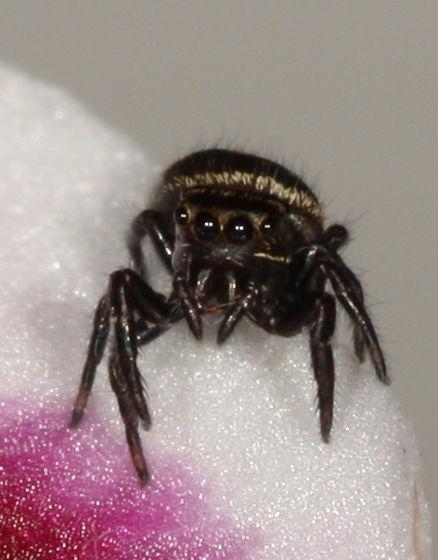

Late Juveniles and Subadults (i6+)
As jumping spiders approach adulthood:
premolt periods become longer
feeding often increases between molts
sex differences become easier to identify
Subadult males often develop:
enlarged pedipalps
slimmer bodies
longer legs
Subadult females often appear:
larger-bodied
fuller-abdomened
develop visible epigynal structures underneath the abdomen.
Epigynal: Referring to the female spider’s reproductive area on the underside of the abdomen, which becomes more visible and developed as the spider approaches adulthood.
Jackson defined the subadult as “the instar immediately preceding the final molt” (Jackson, 1978).
Husbandry During Subadult Stages
Subadults are especially vulnerable during their final molt.
During this stage:
stable hydration becomes extremely important
dangerous fall hazards should be minimized
disturbance should remain low
Do not force-feed spiders during premolt. Refusing food before the final molt is completely normal behavior.

Adult Stage
After the final molt, the spider becomes an adult.
Adult spiders:
no longer molt
are sexually mature
begin adult reproductive behavior
Jackson found that males generally matured earlier and had shorter adult longevity than females (Jackson, 1978).
Adult males often become:
more exploratory
more active
less focused on feeding as they search for mates
Adult females often maintain:
stronger feeding responses
larger body size
eventually produce egg sacs if paired successfully
Husbandry During Adulthood
Adult spiders still require:
hydration
proper ventilation
safe climbing surfaces
appropriately sized prey
However adults will never molt again. Many older adult spiders gradually lose grip strength and may struggle climbing smooth acrylic or glass surfaces later in life.

What Scientific Research Tells Us About Better Husbandry
Scientific studies provide several important husbandry insights.
A study on Phidippus audax found that spiders raised entirely on dead prey survived, but experienced lower survival rates and longer developmental times compared to spiders fed live prey (Vickers et al., 2014).
This suggests that live prey movement likely plays an important role in:
stimulating feeding behavior
encouraging natural hunting responses
supporting healthier development.
Another important study by Gardner observed that spiders raised under warm laboratory conditions matured earlier, but also died earlier (Gardner, 1967).
This is extremely important for husbandry because it suggests faster development is not always healthier development.
Overly warm captive conditions may accelerate:
metabolism
maturation
and aging
Stable, moderate environmental conditions are generally safer than constantly pushing spiders toward rapid growth.
Final Thoughts
Understanding instars and molting is one of the most important parts of successful jumping spider care. As jumping spiders develop their feeding needs, enclosure requirements,social tolerance, and molting behavior all change significantly. Scientific research helps explain why these changes happen and allows keepers to make better husbandry decisions throughout every stage of development. By understanding how jumping spiders naturally grow and molt, we can create healthier and safer captive environments that better support them from postembryo to adulthood.
Works Cited
Gardner, B. T. 1967. The Life-Cycle of the Spider Phidippus coccineus (Salticidae) Under Laboratory Conditions. Psyche 74:104–106.
Gōté, J. T., Butler, P. M., Zurek, D. B., Buschbeck, E. K., & Morehouse, N. I. 2019. Growing tiny eyes: How juvenile jumping spiders retain high visual performance in the face of size limitations and developmental constraints. Vision Research 160:24–36.
Hill, D. E. 2006. The Structure of the Central Nervous System of Jumping Spiders of the Genus Phidippus (Araneae: Salticidae). Republication Version 1.
Jackson, R. R. 1978. The Life History of Phidippus johnsoni (Araneae: Salticidae). Journal of Arachnology 6:1–29.
Kozmic Dreams. n.d. My Digital Photography of Baby Phidippus audax Jumping Spiders. Available at: https://kozmicdreams.com/spidersbaby.htm. Accessed May 10, 2026.
Vickers, M. E., Robertson, M. W., Watson, C. R., & Wilcoxen, T. E. 2014. Scavenging Throughout the Life Cycle of the Jumping Spider Phidippus audax (Hentz) (Araneae: Salticidae). Journal of Arachnology 42:277–283.


Comments